
Category Archives: Lyme Basics

Where’s the Anxiety Coming From? A Surprising Answer.

IMG_1468

Photo: LifeLoveLyme

This morning when I woke up, I realized that I actually felt refreshed.

I had not endured a night of constant shifting trying to relieve body pain. Or of bolting up eyes wide open at one a.m. and then finding myself stuck awake with raging insomnia for four or five hours. And the thing that struck me most this morning was, I felt at peace.

Lyme disease can affect every part of your body, but many people don’t realize how hard it can hit the brain. For me, one of the biggest symptoms has been crushing anxiety.

I wasn’t particularly surprised; when you’re in constant pain, can’t work, can’t dress or cook or do your own grocery shopping, you lose your sense of self and the worrying escalates. Will I ever feel ok again? Will I ever do the things I used to do, will I be able to work? How am I going to survive financially?

My worrying became debilitating, full-blown anxiety. A therapist helped me deal with it, and medication took the edge off on many tough days.

Here’s a surprise: I had no idea that that the anxiety I struggled with isn’t just triggered by the stress of this chronic illness, but by actual physiological changes in the brain kicked off by Lyme and co-infections.

Continue reading

Video: Musician Daryl Hall Tells His Lyme Disease Story

Seems like years since I’ve heard a Hall and Oates song, but this interview on YouTube sure caught my eye. I’m so glad famous people like Daryl are sharing their personal lyme stories.

Notice how his symptoms gradually built up until the day he crashed and couldn’t ignore them any more. If more people knew about how often lyme—”the great imitator”— is mistaken for other things, they could get on the path to good health sooner.

Also take note: he’s recovering – you will, too.

5 Ways to Help Others “See” Lyme

312873_529187227100852_845536526_n

Actually, I’ve learned many people need a little help from me to truly see the pain.

Lyme is known as an “invisible” disease. That’s because oftentimes we look pretty good on the outside despite feeling myriad symptoms inside. And—unfortunately—many of us are darned good at keeping those symptoms invisible.

My own reasons include:

  • I don’t want those around me to worry.
  • Pride.
  • I don’t want people to know how sick I really am because I’m afraid they’ll abandon me.
  • I hate the thought of becoming that depressing person who is constantly complaining about how crummy he or she feels.

But I’ve come to see that a dose of reality is a good thing. When people understand the seriousness of this illness, they offer empathy and support.

Beyond that, we need others to know how serious chronic Lyme can become, so more people understand diagnosis and prevention—and stay well.

Continue reading

Believing in Lyme When Looks Are Deceiving

Credit: Lyme Chick's Facebook page

Credit: Lyme Chick

“You look great!”

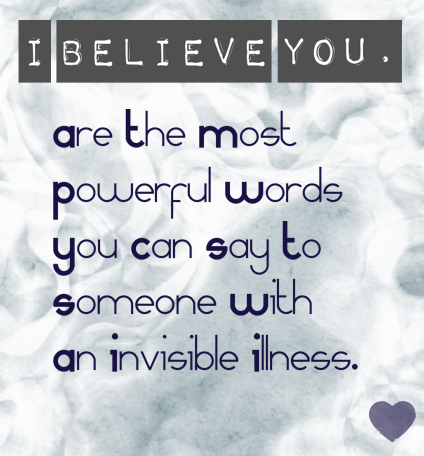
Many days, I wince when someone says that to me. I want to shout in frustration “I FEEL AWFUL!” And when I try to explain, I want to hear “I believe you”—not “But really, you do look great!”

I’ve felt hurt because even those closest to me don’t see my suffering sometimes. But I’m realizing it’s hard for them to believe how awful lyme can be if I don’t clue them in. Especially when it comes to pain. 

Not long ago, my longtime neighborhood book group got together for a potluck dinner. I was just getting to the point in my recovery where I could leave the house occasionally. So I said I’d love to come if I felt okay. Especially because they let me off the hook when it came to cooking a contribution for the table, which I knew I couldn’t manage.

Happily, I made it to the dinner. A few days later someone sent around a photo that included me. By the time I checked my email, a couple of others in the picture had piped up, making jokes about how the picture should have been photo-shopped…the usual chatter of people who hate photos of themselves.

I’m usually one of them. But I opened the file and had to admit I looked, well—great. Yes, great.

The thing is, I felt like hell on the inside.

Continue reading

Surprised There Aren’t More News Reports About Lyme? Help Get the Word Out

Credit: David Boyle in DC's flickr stream

Credit: David Boyle in DC’s flickr stream

Since learning so much about the horrendous impacts of lyme disease—and living many of them—I am absolutely astonished that I don’t see coverage of this health crisis daily in the news. Lack of information is the reason I got so sick myself.

The few articles I’d seen before I got infected erroneously said lyme is easily treated with a short course of antibiotics, and implied that lyme is no big deal. While this is true for many people, for many others it couldn’t be further from the truth.

I had read that a negative test means you aren’t infected. That’s simply not true; testing is inaccurate. Too bad my health care provider and I didn’t get that information.

Sure, a smattering of articles appear here and there. But not enough. And not enough with a full and accurate picture of this complex illness—and the controversy surrounding it.

Meanwhile,  I’m encountering or hearing about lyme patients every single day now, and just about all of them say they never knew it could be so devastating—or so complex to diagnose and treat—until they got it.

Shouldn’t lyme be covered as often as possible in the media so people can protect themselves? Shouldn’t everyone be alerted so they know how to get a proper diagnosis and treatment if they’ve been infected by a tick? 

Here’s some good news: From my local support group to LymeDisease.org, there’s buzz about a fantastic series of articles on lyme—a series many hope will make it into the Pulitzer Prize spotlight.

Continue reading

Killing Good Bacteria with the Bad

Do the probiotics I take replace the good bacteria wiped out by antibiotics?

Do the probiotics I take replace the good bacteria wiped out by antibiotics?

I’m pretty tired of that perky Jamie Lee Curtis and her “Activia” ads on television. Yeah, I’ll admit it, maybe I’m just jealous that she looks so damned good at her age, while I feel my own looks sliding into oblivion as the years slide by.

But I’ll admit she delivers an important message in those yogurt ads—good bacteria promote digestive health. And I’ve learned they do much more.

A riveting article by Michael Specter titled “Germs are Us” in the October 12 (2012) New Yorker magazine addresses this question: “Bacteria make us sick. Do they also keep us alive?”

Specter reports that “…the destruction of bacteria may contribute to Crohn’s disease, obesity, asthma, and many other chronic illnesses.”

As if I didn’t have enough to worry about with threatening bacteria like Borrelia burgdorferi and Babesia microti roving my body and making me sick, I’m quite concerned that antibiotic treatment is killing too many good guys among the tens of thousands of bacteria species in my body. Continue reading

Lyme: Lessons Learned

Taking care of yourself isn’t, well, rocket science…
[Dr. Robert Goddard. Credit: NASA on Flickr/The Commons]

I’ve had the misfortune of getting re-infected just as I was pulling out of two-plus years during which I was largely sidelined by lyme and other tick-borne infections. There’s a bit of good news, however. I learned a few things the first time around, and I’m doing things differently.

Here are some lessons I’ve learned. Maybe you can benefit by taking them to heart now, instead of learning the hard way like I did over time and missing out on benefits you could have enjoyed much, much sooner. Continue reading

5 Things to Know When Someone You Love has Lyme

 
  1. Lyme is a roller coaster. Your friend or family member may make plans, then cancel at the
    Credit: Courtney Fox

    Credit: Courtney Fox

    last minute because they’re suddenly overcome by illness, fatigue, pain—or an array of other symptoms. They are not blowing you off; in fact, they are probably intensely disappointed. Let them know you’re happy to reschedule.

  2. Lyme is debilitating. Imagine how frustrating it would be to find yourself unable to walk to the mailbox in front of your house, fix meals and empty your dishwasher, or drive yourself places. You can make a huge difference by offering help with a task or two.
  3. Lyme symptoms can be invisible. If you find yourself thinking, “My friend looks terrific,” catch yourself. Here’s the key: Ask, “On a scale of 1-10, with 1 being terrific and 10 the absolute worst, how are you doing today?” The answer may surprise you.
  4. Lyme hurts the bank account as well as the body. The sad fact is that insurance often doesn’t fully cover treatment for this disease. And Lyme patients lose income if they are too sick to work. Be sensitive to that; your friend may be spending every penny on getting well, with none left over for a movie or meal out. Suggest free things, or make clear your plan to treat.

Lyme makes eating a challenge. Some patients suffer stomach trouble from tick-borne infections and/or medications used to treat them. Plus, certain foods actually increase the inflammation at the root of their pain. Nutrition is key to healing. Your friend or relative will be so grateful if you get them a gift certificate for carry out or offer to make a meal—and ask which restaurants/foods are the best choice.

For more insight, you might want to read some of these posts – or just browse around yourself using the categories search on the right. 

5 Gift Ideas for Someone with Lyme

5 Ways to Help Others “See” Lyme

Believing in Lyme When Looks Are Deceiving

and here’s an essay from Spirochick addressing an interesting disparity: Empathy: Cancer versus Lyme

For the latest news and research, visit www.facebook.com/LifeLoveLyme.